Start the conversation
Same form, every page. Tell us once — we route it to whoever's closest to your tote.
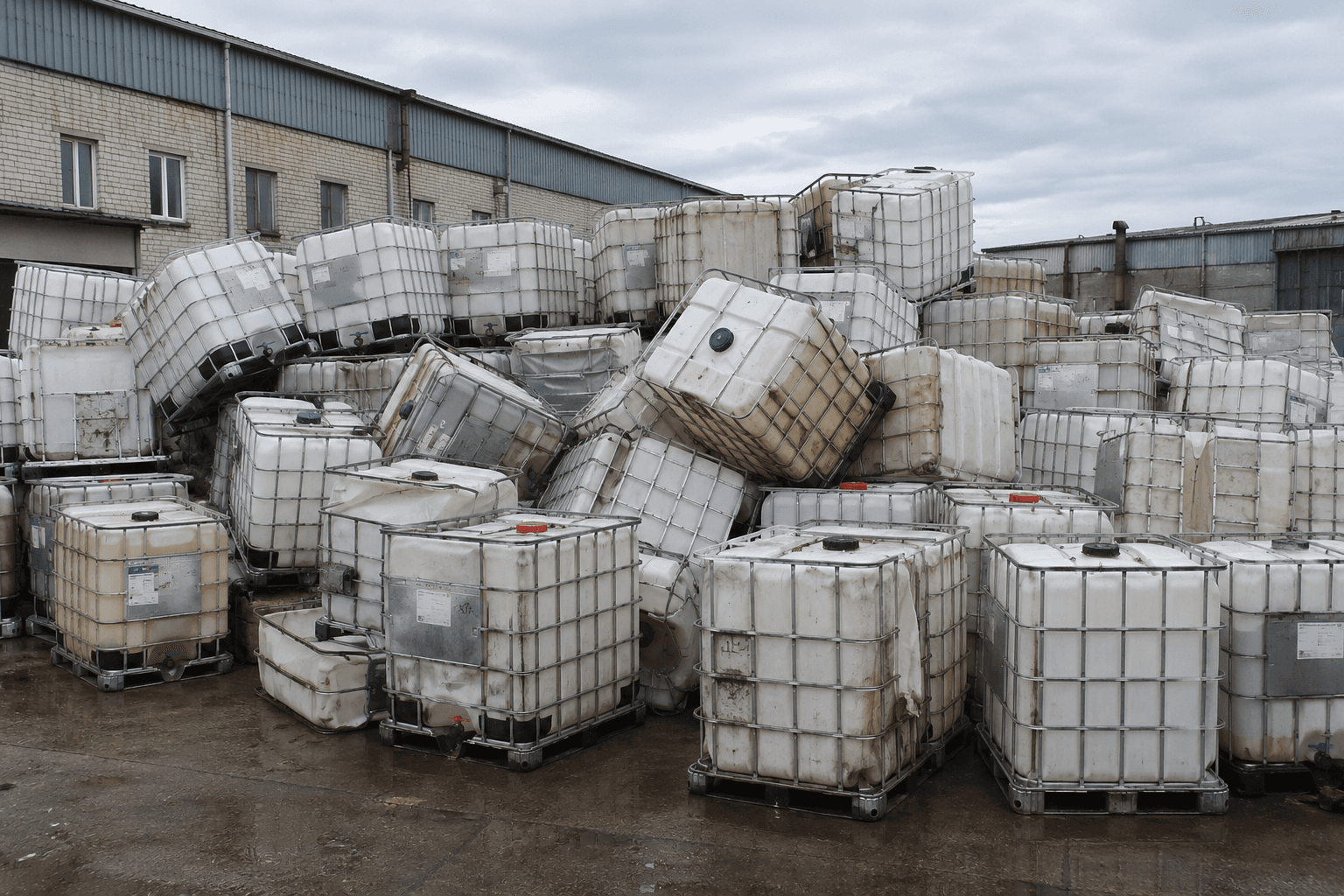
We try reuse before recycling.
A washed and resold tote keeps roughly 96% of the embodied carbon of a new tote. A ground-down tote keeps about 41%. Recycling is plan B for us, not plan A.
We tell you what was in it.
Every tote leaves our yard with a chain-of-custody tag listing the previous fill and the wash cycle it received. No mystery liquid stories.
We don't sell food-grade what wasn't.
Grade A goes only to totes that previously held food-contact materials AND passed a tri-stage wash. We'd rather lose the sale than mis-grade a tank.
We route freight intelligently.
Empty backhauls are the silent carbon cost of the IBC trade. We consolidate pickups within 100 miles and use return trips on outbound loads whenever possible.
When a tote can't be reused, we cut it up.
Damaged tanks become rain barrels, growing beds, fish-pond liners, and weighted ballast. The pieces that can't become anything go to a single Michigan HDPE recycler we've vetted.
One reused 275-gallon tote saves:
Figures derived from EPA WARM model v15 (HDPE manufacturing pathway) and Plastics Industry Association embodied-energy data, cross-checked against the 2023 Sustainable Packaging Coalition IBC study.
How we calculate the embodied-carbon savings.
The 285-lb-per-tote figure isn't a marketing number. It's the convergent middle estimate of three independent sources. Here's the work.
Source 1 — EPA WARM model v15. The Waste Reduction Model used by the EPA assigns embodied carbon to specific waste streams based on lifecycle assessment. For HDPE manufactured from virgin feedstock, the WARM v15 figure is 2.51 metric tonnes CO₂e per metric tonne of HDPE produced. Applied to the 65.3 kg of HDPE in a typical 275-gallon tote bottle, that's 164 kg CO₂e — or 362 lb. WARM is conservative on the manufacturing pathway.
Source 2 — Plastics Industry Association embodied-energy study (2022 ed.). This study breaks out energy and carbon by polymer family, including HDPE specifically. The PIA figure works out to roughly 2.04 metric tonnes CO₂e per metric tonne of finished HDPE — 134 kg or 295 lb for our tote. PIA includes manufacturing electricity and process steam but excludes inbound resin freight, so this is the lower end of the three.
Source 3 — Sustainable Packaging Coalition 2023 IBC analysis. SPC published a focused study on the embodied carbon of HDPE intermediate bulk containers. Their figure for a new 275 — bottle plus cage plus pallet plus inbound freight to first fill — is 296 lb CO₂e. Their methodology is the most directly applicable to our specific question.
The convergent estimate. The three sources cluster around 285–362 lb depending on what's included. We use 285 lb as our headline figure because it's the conservative middle estimate that doesn't double-count freight. The reconditioned figure of 12 lb covers the wash chemistry, the rinse water heating, the gasket replacement, and our averaged inbound/outbound freight allocation.
The ratio. 12 lb divided by 285 lb is 4.2%. That's where our 96% reduction headline comes from. The margin of error on the ratio is roughly ±2% depending on freight assumptions — a buyer 90 miles away gets a slightly better ratio than a buyer 400 miles away, but it's the right order of magnitude either way.
A typical year of reuse for a mid-sized buyer.
“Reuse beats recycling by a factor of 2.3 on the embodied-carbon ledger for intermediate bulk containers. That's not a close decision — that's a slam dunk.”
— Andre Plowman, co-founder
The less-obvious ways we make sustainability work.
Wash chemistry recovery — our caustic wash water is captured, neutralized to pH 7.0 ±0.2, and either routed to a permitted municipal industrial sewer connection or trucked to an industrial waste hauler. It never goes onto the yard or into a storm drain. Most reconditioners can't say the same.
Pallet reclamation — every pallet that comes in with an inbound tote is inspected. Roughly 60% are reusable for outbound. Of the remaining 40%, we send most to a local pallet refurbisher. Less than 2% goes to landfill.
Cage repair — when a tote comes in with a slightly bent cage, we straighten it on a hydraulic press rather than scrapping it. This adds about 12 minutes of labor per tank but keeps roughly 800 tank cages a year from the scrap pile.
Heat recycling — the hot rinse stage uses water heated by a natural-gas boiler. Spent hot water from rinse goes through a heat exchanger to preheat the inbound water for the next batch. We recover roughly 40% of the input thermal energy this way.
Drive route optimization — every outbound truck runs through our routing software, which minimizes empty backhaul miles. Our 2024 freight fuel cost per tank moved was 38% lower than 2021's, almost entirely because of better routing.
If you only read one section.
- 01Reuse keeps 96% of the embodied carbon. Recycling keeps 41%. The default should be reuse.
- 02Every Grade A reconditioned tote we ship is a tank we kept out of a landfill. We've done this ~250,000 times since 2007.
- 03Sustainability is a logistics problem. Our consolidation routing reduces per-tank freight carbon by roughly half versus standalone shipping.
- 04We capture and neutralize wash chemistry. We don't put caustic into the storm drain. Ask other reconditioners what they do with theirs.
- 05Our chain-of-custody documentation makes a tote auditable. Auditable reuse is the bridge between sustainability theater and sustainability accounting.